How to Calculate Carton Quantity, Gross Weight, and Shipping Volume
Learn how to calculate carton quantity, gross weight, CBM, and volumetric weight for custom packaging and international shipping.
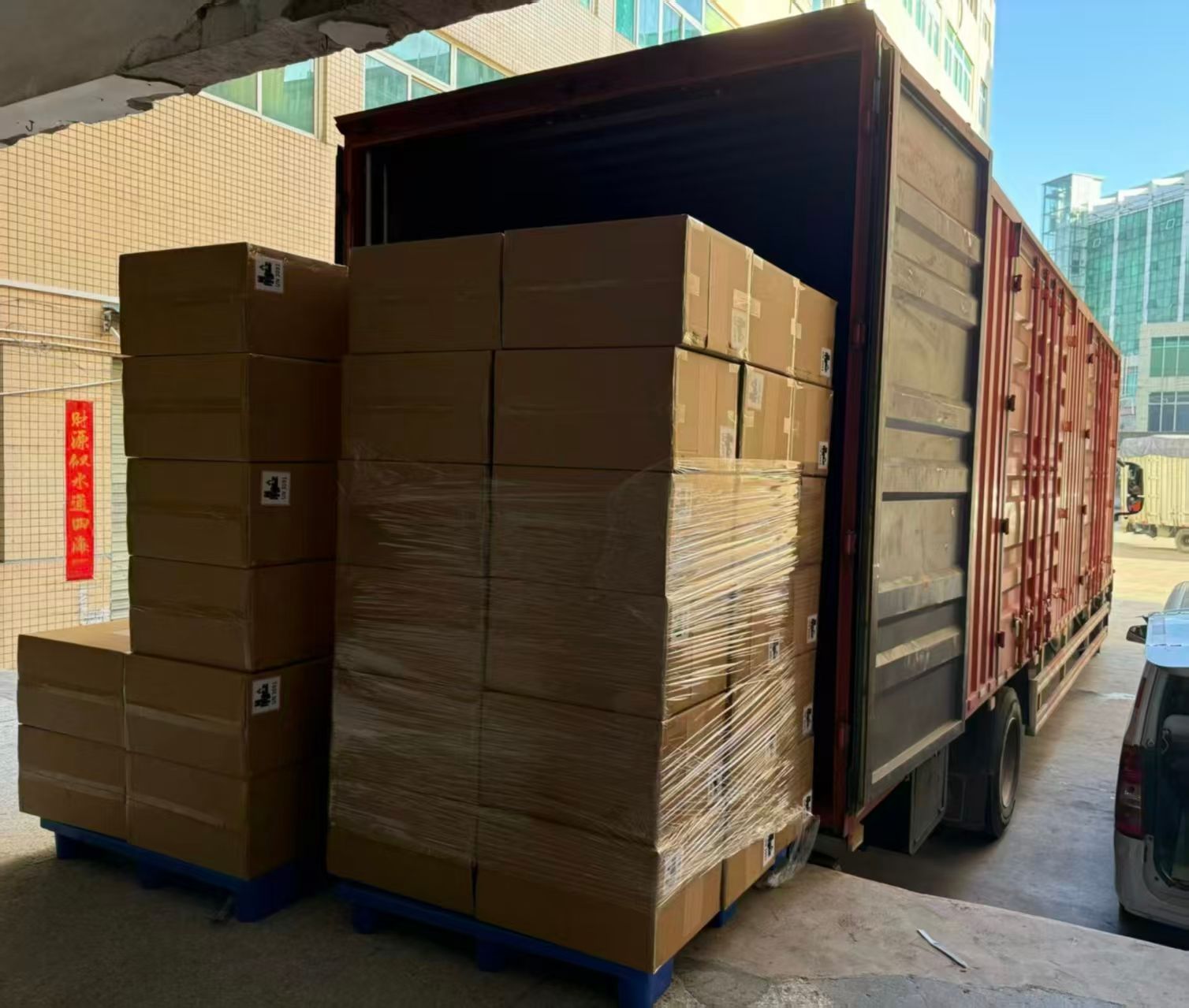
Once custom packaging has been produced, the quantity per carton, gross weight, and shipping volume can directly affect storage, handling, and international freight costs.
These figures cannot be calculated by simply dividing the master carton dimensions by the box dimensions. The packaging structure, packing orientation, carton strength, and carrier’s charging rules must also be considered.
1. How Do You Calculate Quantity per Carton?
Quantity per carton means the number of finished packaging boxes packed inside one master carton. It is normally shown as pcs/ctn.
Suppose the folded size of one packaging box is 35 × 18 × 3 cm, while the usable internal dimensions of the master carton are 55 × 38 × 33 cm.
- Along the length: 55 ÷ 35 = 1 piece
- Along the width: 38 ÷ 18 = 2 pieces
- Along the height: 33 ÷ 3 = 11 pieces
The theoretical quantity is:
1 × 2 × 11 = 22 pieces per carton
Space may still be required for protective bags, tissue paper, corner protectors, and packing operations. The final quantity might therefore be adjusted to 20 pieces per carton.
2. Why Test Different Packing Orientations?
Rotating the same box can produce a different packing quantity. Several orientations should be compared to find an arrangement that offers good space efficiency without compressing or damaging the packaging.
The arrangement with the highest quantity is not always the best. If the carton becomes too heavy, unstable, or difficult to handle, the quantity should be reduced.
3. Packing Different Box Styles
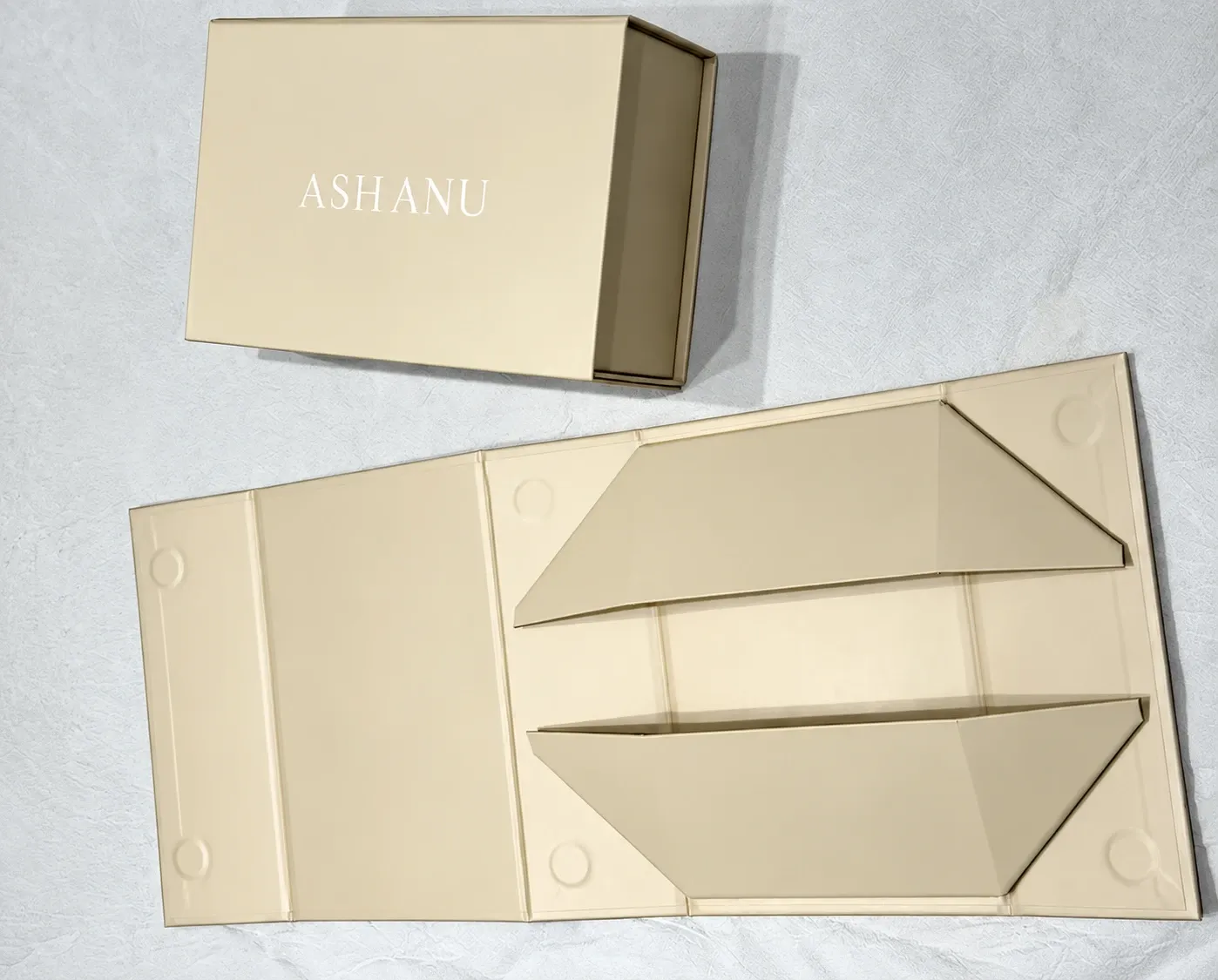
Collapsible Magnetic Boxes
These boxes can be shipped flat, significantly reducing shipping volume. Magnets, adhesive strips, and folding panels should be protected against pressure marks.
Standard Rigid Boxes
Lid-and-base, book-style, and drawer boxes normally cannot be completely flattened. Their packing quantity should be calculated according to the finished external dimensions.
Corrugated and Irregular-Shaped Boxes
Foldable corrugated boxes can usually be packed flat. Round, polygonal, or other unusual structures generally require a physical packing test.
4. How Do You Calculate Gross Weight?
For example:
- Weight of one collapsible box: 0.42 kg
- Quantity per carton: 20 pieces
- Master carton weight: 1.10 kg
- Protective materials: 0.30 kg
The gross weight is:
0.42 × 20 + 1.10 + 0.30 = 9.80 kg
Net weight (N.W.) normally refers to the products only. Gross weight (G.W.) also includes the shipping carton and all protective materials. Freight quotations are generally based on gross weight.
5. How Do You Calculate Shipping Volume?
International shipping volume is commonly measured in cubic metres, or CBM.
For a carton measuring 55 × 38 × 33 cm:
55 × 38 × 33 ÷ 1,000,000 = 0.06897 CBM per carton
For 40 cartons:
0.06897 × 40 = 2.7588 CBM, which can be stated as approximately 2.76 CBM.
6. What Is Volumetric Weight?
Air freight, international express, and some road freight services compare actual gross weight with volumetric weight and normally charge whichever is higher.
Common divisors include 5,000 and 6,000, although the exact standard should be confirmed with the carrier.
For a carton measuring 55 × 38 × 33 cm:
- Using 5,000: 13.79 kg
- Using 6,000: 11.50 kg
If the actual gross weight is 9.80 kg, the carrier may charge the carton as 11.50 kg or 13.79 kg.
7. Sea Freight, Air Freight, and Express Shipping
- Sea freight: Usually focuses on total volume, minimum chargeable volume, and destination charges.
- Air freight: Compares actual and volumetric weight and charges the higher figure.
- International express: Usually calculates volumetric weight for every carton and may round up carton dimensions.
For lightweight but bulky rigid boxes, reducing shipping volume may save more than reducing a few kilograms of weight.
8. How Can Shipping Costs Be Reduced?
- Use a collapsible structure where possible
- Compare different packing orientations
- Reduce unnecessary empty space
- Avoid oversized or excessively heavy cartons
- Prepare different packing plans for air and sea freight
- Pack, weigh, and measure finished production boxes
How Does HKY PACKAGE Confirm Packing Data?
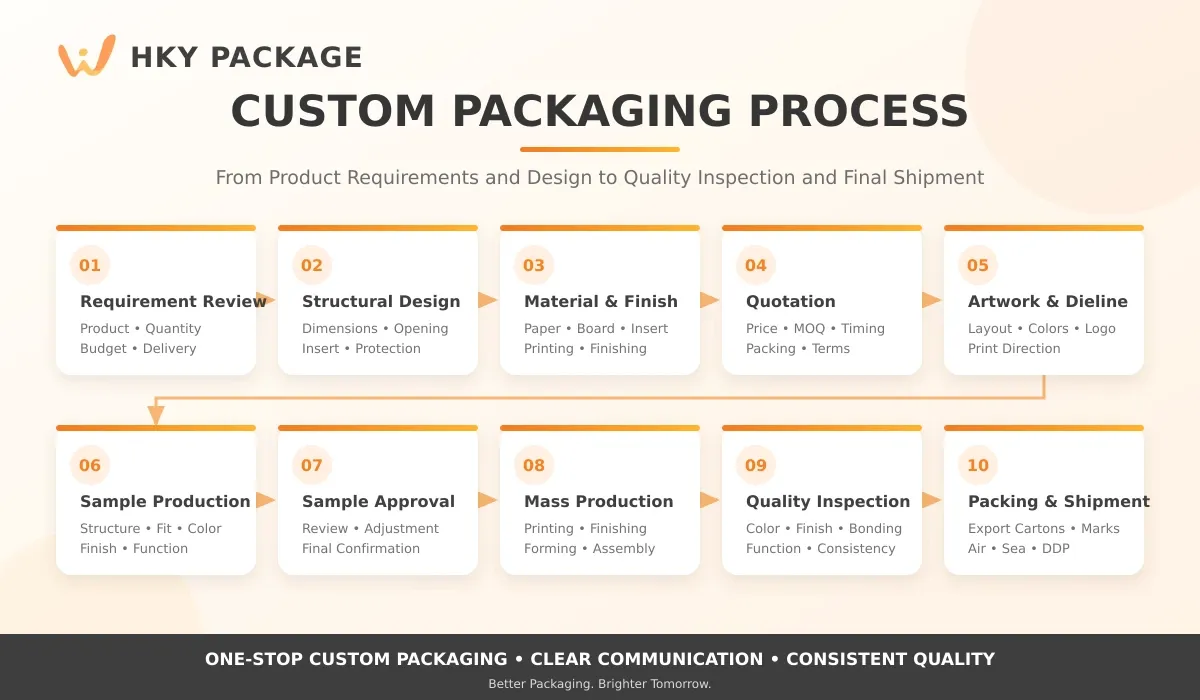
For each custom packaging project, HKY PACKAGE estimates the carton quantity, gross weight, and shipping volume according to the box style, dimensions, materials, inserts, and intended shipping method.
After mass production, we can reconfirm:
- Quantity per carton and master carton dimensions
- Net and gross weight per carton
- Total cartons, gross weight, and shipping volume
- Palletisation requirements
- Air, sea, express, or DDP shipping options
Accurate packing data helps brands control logistics costs and reduces the risk of compression, deformation, and carton damage. HKY PACKAGE helps you find the right balance between appearance, protection, cost, and transportation efficiency.